
Noise Barrier: Complete Guide to Noise Reduction, Types, Applications & Selection
Noise pollution has become an increasing concern around highways, expressways, railway corridors, industrial areas, construction zones, commercial developments, and densely populated urban locations. Continuous traffic and industrial noise can affect the comfort and acoustic environment of nearby communities.
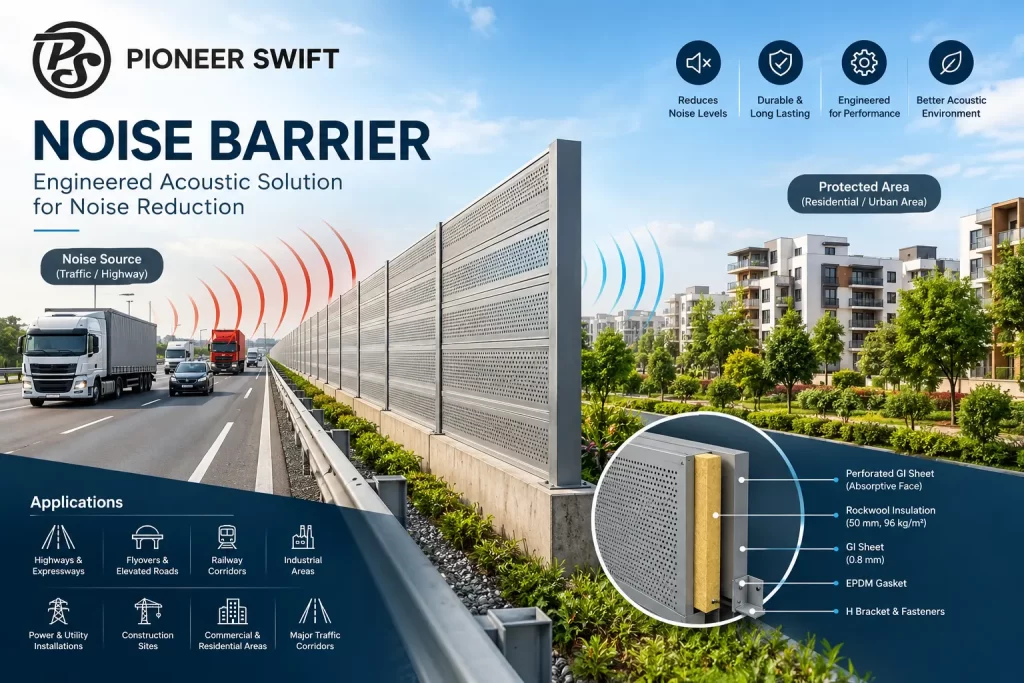
A Noise Barrier is an engineered acoustic solution designed to reduce the transmission of unwanted sound from a noise source to nearby residential, commercial, or sensitive areas. Depending on the application, noise barriers can be designed with sound-absorbing, sound-reflecting, or combined acoustic properties.
For highways, elevated roads, industrial facilities, and other high-noise environments, selecting the right barrier system is important for achieving effective noise control while maintaining durability and structural performance.
What Is a Noise Barrier?
A Noise Barrier is a physical structure installed between a noise source and the area that needs protection. It interrupts the direct path of sound waves and helps reduce the amount of noise reaching the receiver.
Noise barriers are commonly installed along:
- Highways and expressways
- Flyovers and elevated roads
- Railway tracks
- Industrial facilities
- Power and utility installations
- Construction sites
- Commercial and residential developments
- Areas located close to major traffic corridors
The effectiveness of a noise barrier depends on factors such as its height, length, location, acoustic properties, material, installation quality, and the characteristics of the noise source.
How Does a Noise Barrier Work?
A Noise Barrier works primarily by blocking the direct line of sight between the noise source and the receiver.
For example, when a vehicle produces road traffic noise, sound waves normally travel toward nearby buildings and communities. When a properly designed barrier is placed between the road and the protected area, the direct sound path is interrupted.
The sound must travel over or around the barrier, increasing the distance and reducing the sound energy reaching the receiver.
In an absorptive Noise Barrier, acoustic insulation and an absorptive surface can also help reduce reflected sound.
This makes absorptive systems particularly useful in environments where controlling both transmitted and reflected noise is important.
What Is an Absorptive Noise Barrier?
An absorptive Noise Barrier is designed not only to block the transmission path of sound but also to absorb a portion of the sound energy.
Unlike a simple solid reflective wall, an absorptive panel generally incorporates an acoustic material and a perforated or acoustically designed face.
A typical absorptive system may include:
- Perforated metal acoustic face
- Mineral wool or Rockwool insulation
- Protective layers
- Metal outer skin
- Sealing gaskets
- Structural brackets
- Mechanical fasteners
The combination of these components provides an engineered solution for applications where effective noise reduction and durability are required.
Key Features of a Noise Barrier Panel
The performance of a Noise Barrier depends heavily on its construction and installation.
Pioneer Swift’s Noise Barrier system is designed as an absorptive panel system with fittings, gasket, and installation components according to approved drawings and specifications.
The product specifications include:
- Panel height: 1000 mm, configured as 500 mm × 2
- Panel thickness: 85 mm
- Panel length: 3000 mm
- Skin material: 0.8 mm thick GI sheet
- Absorptive face: Perforated GI sheet
- Insulation: 50 mm Rockwool with a density of 96 kg/m³
- Water protection: Fiberglass layer at the front side
- Gasket: EPDM rubber gasket
- Bracket: H bracket, 104 mm × 120 mm × 2.8 mm thickness
- Mechanical fasteners: M16 × 150 mm, 4 Nos. or as required by design
These specifications make the system suitable for projects where acoustic performance needs to be combined with a robust panel construction.
Where Are Noise Barriers Used?
1. Highways and Expressways
Road traffic is one of the most common sources of environmental noise. Noise Barriers can be installed along highways and expressways to help reduce traffic noise reaching nearby residential and commercial areas.
2. Flyovers and Elevated Roads
Elevated roads can bring traffic noise closer to buildings. Acoustic barriers installed along the sides of flyovers can help interrupt the direct path of traffic noise.
3. Railway Corridors
Railway operations can generate significant intermittent noise. Noise barrier systems can be considered near railway corridors where noise mitigation is required.
4. Industrial Areas
Factories, manufacturing facilities, generators, compressors, machinery, and other industrial equipment can create continuous or intermittent noise.
Noise barriers can form part of a broader industrial acoustic-control strategy.
5. Construction Projects
Construction equipment such as drilling machines, generators, concrete equipment, and heavy vehicles can produce high levels of temporary noise.
Temporary or permanent acoustic barriers may be considered depending on the project requirements.
6. Urban Infrastructure Projects
As cities expand and infrastructure becomes increasingly dense, roads and other transportation infrastructure may be located close to homes, schools, hospitals, offices, and commercial buildings.
In such situations, properly designed acoustic barriers can contribute to better environmental noise management.
Benefits of Installing a Noise Barrier
A well-designed Noise Barrier can provide several benefits:
Reduced Traffic Noise
The primary purpose is to reduce the amount of unwanted sound reaching protected areas.
Improved Acoustic Environment
Noise barriers can help create a more comfortable acoustic environment around roads, infrastructure, and industrial facilities.
Absorption of Sound
Absorptive panels can help manage sound energy at the barrier surface instead of relying solely on sound reflection.
Durable Construction
Metal-based panel systems can be engineered for demanding outdoor environments when the correct materials, protective coatings, fittings, and installation methods are used.
Flexible Project Applications
Noise barrier systems can be designed and installed for different infrastructure and industrial applications according to project requirements.
Noise Barrier vs Soundproof Wall: What Is the Difference?
A Noise Barrier and a building soundproofing system are not exactly the same.
A Noise Barrier is generally installed outdoors between a noise source and a receiver. Its purpose is to interrupt the outdoor transmission path of sound.
Soundproofing, on the other hand, generally focuses on reducing sound transmission through a building element such as a wall, ceiling, floor, door, or window.
For example:
Highway → Noise Barrier → Residential Area
is an outdoor noise-control application.
Whereas:
Noisy Room → Acoustic/Soundproof Wall → Adjacent Room
is a building sound-transmission application.
Understanding this difference helps project owners select the right acoustic solution.
How to Choose the Right Noise Barrier?
Choosing a Noise Barrier should not be based only on price. Several technical and site-specific factors should be considered.
1. Identify the Noise Source
Determine whether the primary noise comes from road traffic, railway operations, industrial machinery, construction activity, or another source.
2. Understand the Required Noise Reduction
A qualified acoustic assessment can help determine the required performance level for the project.
3. Consider Barrier Height
Barrier height can significantly influence the acoustic performance because it determines how effectively the direct sound path is interrupted.
4. Select the Right Material
The material should provide the required acoustic and structural performance while being suitable for the installation environment.
5. Consider Absorptive Construction
Where reflected noise is a concern, an absorptive Noise Barrier may be more appropriate than a purely reflective barrier.
6. Check Durability Requirements
Outdoor installations may be exposed to rain, dust, sunlight, temperature changes, and other environmental conditions. Material protection and construction quality should therefore be considered.
7. Focus on Proper Installation
Even a high-quality panel may not deliver its intended performance if there are significant gaps, poor sealing, incorrect mounting, or unsuitable structural support.
Why Proper Installation Matters
A Noise Barrier functions as a system rather than simply as an individual panel.
The panel, brackets, fasteners, joints, gaskets, support structure, and installation configuration all contribute to the overall performance.
Gaps between panels can create paths for sound to pass through. Therefore, sealing and correct installation are important considerations during project execution.
Pioneer Swift’s listed Noise Barrier system includes components such as EPDM rubber gaskets, H brackets, and mechanical fasteners as part of the installation system.
Why Choose an Absorptive Noise Barrier?
An absorptive Noise Barrier can be useful when a project requires both sound-path interruption and management of sound energy at the barrier surface.
The use of a perforated GI absorptive face combined with Rockwool insulation provides an engineered panel construction intended for acoustic applications. Pioneer Swift specifies a 50 mm Rockwool insulation layer with a density of 96 kg/m³ in its Noise Barrier panel.
This type of construction can be considered for road, infrastructure, industrial, and other outdoor noise-control projects where an engineered acoustic barrier is required.
Choose the Right Noise Barrier for Your Project
A properly designed Noise Barrier can be an important part of an environmental noise-control strategy for highways, expressways, flyovers, railway corridors, industrial facilities, and urban infrastructure.
For demanding outdoor applications, an absorptive panel system can provide a combination of acoustic functionality, durable construction, and installation components.
Pioneer Swift offers an absorptive-type Noise Barrier Panel with a perforated GI absorptive face, 50 mm Rockwool insulation, GI sheet construction, fiberglass protection, EPDM gasket, H brackets, and mechanical fasteners.
If you are planning a highway, infrastructure, railway, industrial, or other noise-control project, explore the Pioneer Swift Noise Barrier product specifications and system details.
A suitable Noise Barrier should ultimately be selected according to the project’s noise source, acoustic objectives, site conditions, structural requirements, and installation design.Frequently Asked Questions About Noise Barriers
A Noise Barrier is a physical structure installed between a noise source and a receiver to interrupt the direct path of sound and reduce noise transmission.
Noise Barriers are commonly used near highways, expressways, flyovers, railway corridors, industrial facilities, construction areas, and other locations where environmental noise needs to be controlled.
An absorptive Noise Barrier combines sound-blocking construction with acoustic materials and an absorptive surface to help manage sound energy and reduce unwanted reflections.
Yes. Noise Barriers are commonly considered for highway and road infrastructure projects where traffic noise may affect nearby residential, commercial, or sensitive areas. The appropriate design depends on the project’s acoustic and structural requirements.
Noise Barriers can be manufactured using different materials depending on their application. An absorptive metal panel system may use GI sheets, perforated metal surfaces, Rockwool or other acoustic insulation, protective layers, gaskets, brackets, and fasteners.
According to the product specifications, the Pioneer Swift Noise Barrier panel has a thickness of 85 mm and a panel length of 3000 mm.
The listed panel specification includes 50 mm Rockwool insulation with a density of 96 kg/m³.
No. A Noise Barrier is generally an outdoor noise-control structure placed between a source and receiver, while soundproofing typically focuses on reducing sound transmission through building structures.
